Queer Places:
Dartmouth College, Hanover, NH 03755, United States
Barnard College (Seven Sisters), 3009 Broadway, New York, NY 10027
Ridgewood Cemetery, 177 Salem St, North Andover, MA 01845, United States
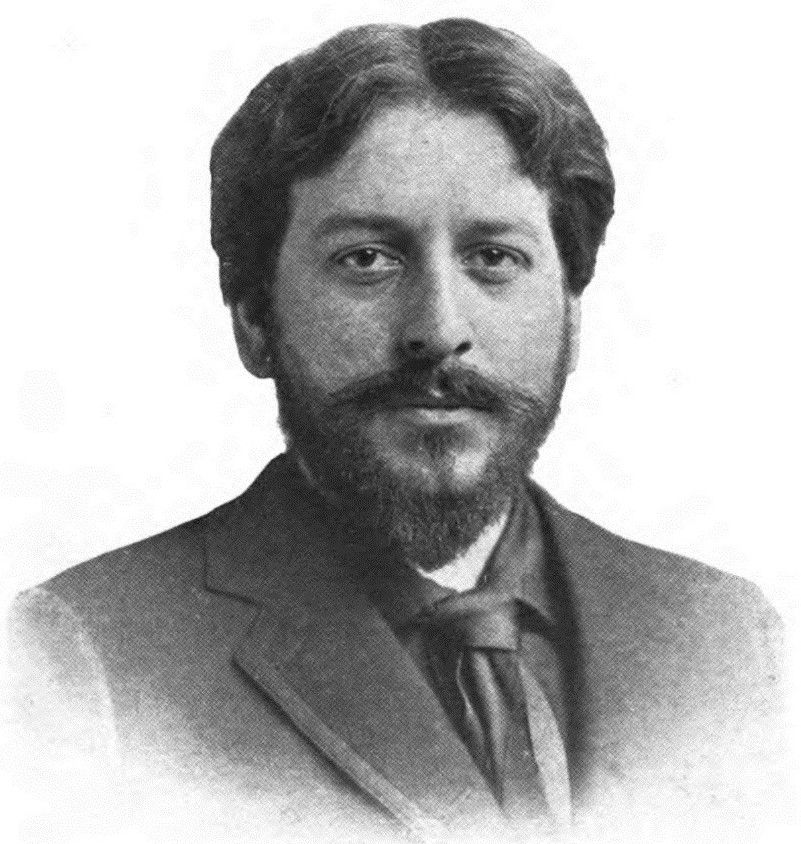 Richard Hovey (May 4, 1864 – February 24, 1900) was born on May 4, 1864, in Normal, Illinois, to Major General Charles Edward Hovey and Harriet Farnham
Spofford Hovey. Growing up, he spent his early years in North Amherst, Massachusetts, and Washington, D.C., before attending Dartmouth College, where he
graduated in 1885. He is well-known for penning Dartmouth's esteemed alma mater song, "Men of Dartmouth." Demonstrating an early passion for writing, he
privately published his first volume of poetry in 1880. Following his undergraduate studies, Hovey spent time studying art and theology, and later lectured
on aesthetics at the Farmington School of Philosophy before spending the final two years of his life teaching as a professor of English at
Barnard College, Columbia University.
Richard Hovey (May 4, 1864 – February 24, 1900) was born on May 4, 1864, in Normal, Illinois, to Major General Charles Edward Hovey and Harriet Farnham
Spofford Hovey. Growing up, he spent his early years in North Amherst, Massachusetts, and Washington, D.C., before attending Dartmouth College, where he
graduated in 1885. He is well-known for penning Dartmouth's esteemed alma mater song, "Men of Dartmouth." Demonstrating an early passion for writing, he
privately published his first volume of poetry in 1880. Following his undergraduate studies, Hovey spent time studying art and theology, and later lectured
on aesthetics at the Farmington School of Philosophy before spending the final two years of his life teaching as a professor of English at
Barnard College, Columbia University.
Hovey’s literary output expanded significantly in the 1890s, highlighted by his ambitious multi-part poetic drama Launcelot and Guenevere (beginning
with The Quest of Merlin in 1891), the elegy Seaward (1893), Along the Trail (1898), and Taliesin, a Masque (1900), alongside translations of plays by
Maurice Maeterlinck. Among his most celebrated works were his collaborations with Canadian poet Bliss Carman,
whom he met in 1887. The pair produced three highly popular volumes of bohemian "tramp" verse: Songs from Vagabondia (1894), More Songs from Vagabondia
(1896), and Last Songs from Vagabondia (released posthumously in 1900). These volumes were published by the Visionists social circle, which included Hovey,
Carman, F. Holland Day, and Herbert Copeland.
Deeply embedded in the Visionists' collaborative artistic community, Hovey and Carman's creative partnership was profound; Carman's biographer noted
that Hovey was his particular friend and that the two reacted intensely upon each other to the mutual advantage of both. Beyond his lyric verse, Hovey
attempted a continuation of Lord Byron’s unfinished masterpiece Don Juan. Samuel Claggett Chew praised
Hovey's "Canto XVII"—supposed to be written by Byron in Hades—as one of the most convincing reproductions of Byron's verse style and satirical spirit.
In his personal life and self-presentation, Hovey was a self-conscious individual in both clothing and mannerisms, often styling himself after
Oscar Wilde. He traveled through Europe with Henrietta Knapp Russell, with whom he had a son, Julian R. Hovey
(born 1892), and whom he later married in 1894.
Richard Hovey died prematurely on February 24, 1900, in New York City at the age of 35, following complications from minor surgery for a varicocele. He
was laid to rest at Ridgewood Cemetery in North Andover, Essex County, Massachusetts. His legacy endures through his contribution to collegiate tradition,
his pivotal role in late-19th-century bohemian poetry, and his enduring artistic partnership with Bliss Carman.
References:
Other references:
- Richard Hovey: Man and Craftsman by Allan Houston Macdonald (Durham, N.C.: Duke University Press, 1957) — A comprehensive full-length biography and critical study of Hovey's life, poetic career, and philosophy.
- Encyclopedia of American Poetry: The Nineteenth Century, edited by Eric L. Haralson (Fitzroy Dearborn Publishers, 1998) — Contains a dedicated entry on Richard Hovey by Bruce Meyer (p. 217).
- To the End of the Trail (1908) — Includes commentary on Hovey's poetic style and his continuation of Lord Byron’s Don Juan.
- "Byron in America" by Samuel Claggett Chew, published in American Mercury, Vol. 1, No. 3 (March 1924), pp. 335–344 (featuring specific praise for Hovey's "Canto XVII" on p. 342).
- The Richard Hovey Collection at Dartmouth College Library — Holds primary source materials, manuscripts, and correspondence concerning Hovey's life, his years at Dartmouth, and his literary works.
Support this project
This website is a passion project researched, developed, and funded entirely by me. If you find the content valuable and would like to help support the ongoing research and hosting costs, any contribution is deeply appreciated.
Thank you for keeping this independent resource alive!
My books on Amazon: Elisa Rolle's books
BACK TO HOME PAGE
